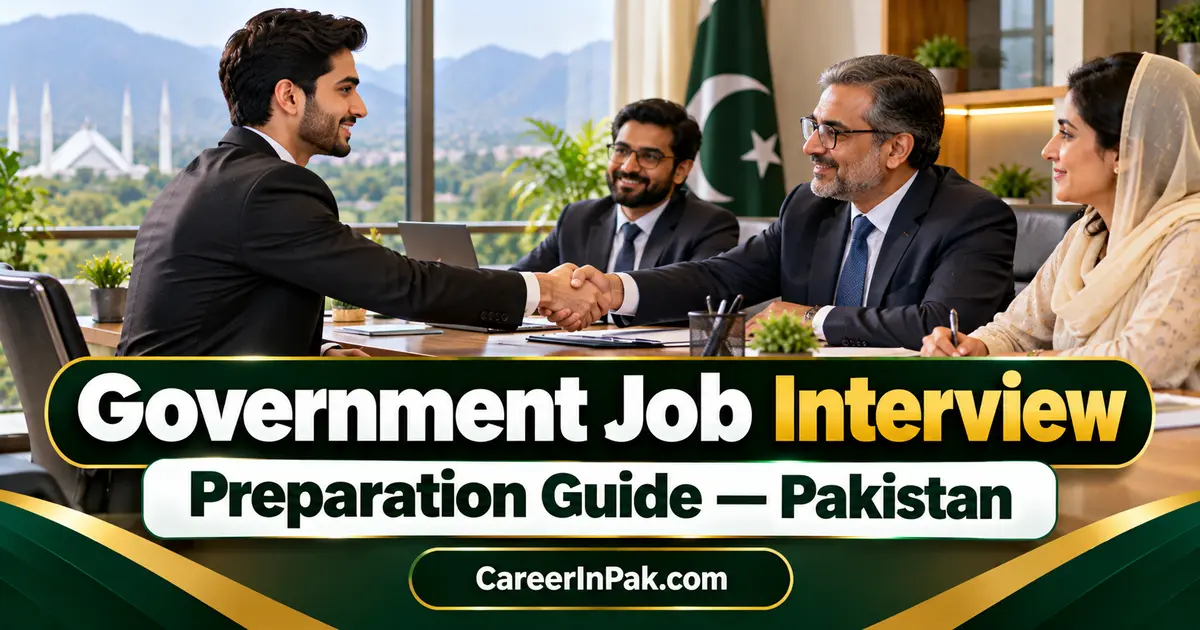
Passing a written test gets you to the interview. It does not get you the job. In a government interview in Pakistan — whether the panel is from the Punjab Public Service Commission, the Federal Public Service Commission, another provincial commission, or a departmental selection committee — the panel already knows you can pass a paper. What it wants to find out in fifteen or twenty minutes is something a paper cannot show: can you explain yourself clearly, do you actually know the post you have applied for, are your documents genuine and complete, and can you stay calm and honest when you do not know an answer?
Most candidates prepare for the interview the wrong way. They memorise long answers from guidebooks, learn lists of facts they will never be asked, and walk in ready to deliver a speech. The panel hears the same speeches all day. What stands out is much simpler: a candidate who has read the advertisement properly, who knows their own application, who answers the question that was actually asked, and who says "I do not know" plainly instead of bluffing. This guide shows you how to prepare that way, question by question.
1. What the Interview Actually Tests
A government interview is not a second written test, and it is not a test of confidence alone. Panels generally weigh five things, and it helps to prepare for each one separately:
- Knowledge of the post and the department. What the post does day to day, which department it belongs to, and what that department is responsible for. A candidate who cannot say what the job involves has not prepared, however good their degree is.
- Knowledge of your own subjects. The subjects of your degree, especially where they connect to the post, plus general knowledge of Pakistan that any graduate is expected to have.
- Communication. Can you answer in clear, ordered sentences, in Urdu or English as the panel uses, without rambling? Panels do not expect perfect English. They expect an answer that can be followed.
- Character and composure. Honesty, respect, patience, and steadiness under a difficult question. Losing your temper, arguing, or boasting all count against you.
- Verification. Do your original documents match what you wrote in the application? This is not a formality. A mismatch in a degree, a date, a domicile, or claimed experience is found here, and it can end a candidature.
Marks, where the recruiting body gives the interview a weight, are awarded across these areas, not for one brilliant answer. A steady performance across all five beats one impressive answer followed by bluffing and confusion.
2. Start from the Advertisement, Not from a Guidebook
Your preparation should start with three documents: the advertisement for the post, your own application, and the interview call letter. Read all three again, slowly, before you open any interview guide.
From the advertisement, note: the exact title of the post, the department, the basic pay scale where stated, the required qualification and experience, the place of posting if stated, and any special condition such as a licence, a skill test, or a physical standard. From your application, note exactly what you claimed — your degrees with years, your experience with dates, your domicile, and any extra qualification you mentioned. The panel will ask about what you wrote, not about what you wish you had written. If you claimed a computer skill, a language, or a short course, be ready to be asked about it.
From the call letter, note: the date, time, and venue; the documents it asks you to bring; and whether it asks for attested copies, photographs, or a fee receipt. Follow the call letter exactly. If it says to report half an hour early, report half an hour early. If it lists a document, bring the original and a copy, even if you are sure it was already submitted online.
Then learn the department. A few hours of reading is enough: what the department does, who heads it, its main offices or attached departments, and one or two current programmes or functions it is publicly known for. You do not need internal or secret information, and you should never claim to have any. Public information — the department's own website, its official notices, and reputable news reporting — is the right source, and it is also the source the panel itself would accept.
3. Documents: Carry Originals, and Check Them the Night Before
Verification failures are the most avoidable reason candidates lose a chance at interview stage. Pack the night before, and check each item against the call letter:
- Original CNIC, plus a copy.
- Interview call letter, printed, plus the original application or roll-number slip where the call letter asks for it.
- Original educational documents, from Matric onwards, with copies — degrees, transcripts, and result cards where a degree is still awaited and the advertisement allowed it.
- Domicile certificate and, where the advertisement asked for it, a Permanent Residence Certificate.
- Experience certificates for every period of experience claimed, with the employer's name, your designation, and the dates. A claim without a certificate is a claim the panel cannot accept.
- Equivalence certificate, where a foreign degree or an unusual qualification was claimed.
- Departmental permission or no-objection certificate, if you are already in government service and the rules required it.
- Disability certificate from the competent authority, if a disability claim or quota was claimed.
- Recent passport-size photographs, if the call letter asks for them.
- A pen. You may be asked to sign an attendance sheet or a declaration.
Put originals and copies in separate folders, in the same order as the call letter lists them. If a document has an error — a spelling difference in your name, a wrong date of birth, a missing stamp — do not hope the panel will not notice. Get it corrected by the issuing body where that is still possible, and if it is not possible before the interview, carry the correction application receipt and be ready to explain honestly. A known error explained in advance is far better than an error discovered by the panel.
4. Dress, Arrival, and Manners
Dress neatly and simply, as you would for a formal office visit. For men, a clean shalwar kameez or a shirt with trousers, with polished shoes, is fully appropriate; a suit is not required. For women, neat formal dress appropriate to a government office is appropriate. Avoid strong perfume, flashy jewellery, and anything that distracts from what you say. The panel forms no mark for expensive clothes, but untidy dress suggests you did not take the occasion seriously.
Reach the venue early enough that a traffic delay cannot make you late, and report at the time the call letter states. Switch your phone completely off before you enter the interview room, not merely to silent — a vibration in your pocket during an answer is a distraction you do not need, and a phone in hand is disrespectful. Greet the panel politely, sit only when asked, and address the chairperson and members respectfully. Listen to the whole question before you answer, and if you do not understand a question, say so politely and ask for it to be repeated. That is better than answering a different question confidently.
Speak at a normal pace and a normal volume. Do not rush, do not whisper, and do not raise your voice to sound confident. If the panel interrupts, stop and listen — they are guiding the interview, not arguing with you. Thank the panel at the end, whatever you think of your own performance. Do not ask about your result, your marks, or your chances as you leave; the panel will not tell you, and asking puts them in an awkward position.
5. "Tell Me About Yourself" — Answer in About One Minute
Almost every interview opens with some version of this question: "Tell us about yourself", "Introduce yourself", or "What have you done since your degree?" It is not an invitation to tell your life story. It is a test of whether you can select what matters.
A good structure, in about four sentences, is:
- Education, briefly. Your highest relevant qualification, the institution, and the year — one sentence.
- Relevant experience or skills. What you have actually done that connects to this post: a job, an internship, teaching, fieldwork, computer or technical skills. One or two sentences, with a concrete detail, not a list of adjectives.
- Why this post. One sentence connecting your background to the post you have applied for.
For example: "I completed my Master's in Public Administration from the University of the Punjab in 2024. Since then I have worked for one year as an office assistant in a district office, where I handled record-keeping and public dealing. I applied for this post because its work — public dealing and record management — is the work I have been doing, and I want to do it in this department." That answer is short, checkable, and relevant. Compare it with a weak answer: a five-minute account of childhood, family, and every course ever attended, ending without ever mentioning the post. The panel will interrupt the second kind of answer, and the interruption itself unsettles the candidate.
Do not memorise your introduction word for word. Memorised answers sound rehearsed, and if you forget one word you may lose the whole answer. Learn the structure and the facts, and speak them in your own words each time you practise.
6. The Common Questions, and How to Answer Each One
The questions below appear, in some form, in most government interviews in Pakistan. For each one, the guide gives what the panel is really asking, a method for answering, and the mistake to avoid. Use the method; do not copy a sample answer. Panels recognise copied answers immediately, and a copied answer that does not match your own record is worse than a plain one.
6.1 "Why do you want a government job?"
What the panel is asking: is your reason this post, or is it any post with a salary? "Job security" alone is a weak answer because it is true for every applicant and says nothing about the work. A stronger answer names the work and the service: the stability of government service matters to you, but so does the nature of the work — public service, a defined role, the chance to work in a field you studied. Keep it honest and short. If the real reason includes family circumstances or a wish to serve in your own district, you may say so plainly; sincerity is more convincing than a grand statement about serving the nation that you do not believe.
6.2 "Why this department / this post?"
What the panel is asking: have you done even basic homework? Answer with one or two specific, public facts about the department's work, and connect them to your qualification or experience. "Because this department works on education / health / revenue administration, and my degree and my experience are in that field" is a real answer. "Because it is a good department" is not an answer at all. Avoid praising the department in general terms, and never claim a personal connection inside the department — panels check, and name-dropping harms you.
6.3 "What are your strengths?"
Name two or three strengths, and prove each with one short example. "I am hardworking" proves nothing. "In my previous job I managed the record room for a year, and during an audit we produced every file the auditors asked for without delay" proves something. Choose strengths that matter for the post: accuracy for a clerical post, patience for public dealing, subject knowledge for a teaching or technical post. Do not list ten strengths; three proved ones are enough.
6.4 "What is your weakness?"
This is the question candidates fear most, and it is also the easiest to answer badly. Two answers fail every time: claiming you have no weakness, which the panel will not believe, and naming a disguised strength, such as "I work too hard" or "I am a perfectionist", which the panel has heard a hundred times. Name a real, modest weakness that does not disqualify you for the post, and say what you are doing about it. For example: "I used to hesitate before speaking in meetings. I have been making a point of presenting in our office meetings, and it has improved." That answer is honest, it shows self-knowledge, and it shows action. Never name a weakness that goes to the heart of the post — a candidate for a public-dealing post should not say they dislike dealing with people.
6.5 "Why should we select you?"
Do not beg, and do not claim to be the best candidate. Summarise, in two or three sentences, the fit: the required qualification, the relevant experience or skill, and your willingness to work where posted. "I meet the qualification, I have one year of relevant experience in record and public dealing work, and I am willing to serve wherever the department posts me" is a complete answer. Comparing yourself with other candidates, or criticising them, is never appropriate.
6.6 "What will you do if you are posted far from home?" / "Will you accept this posting?"
Answer without conditions. Government service includes transfer and posting anywhere the department needs you, and a candidate who sets conditions at interview stage — a particular city, a particular office, a refusal to serve in a rural station — is telling the panel they will be a problem later. If you have a genuine constraint, such as a medical condition or a family responsibility, state it factually and briefly, and leave the decision to the department. Do not invent a constraint, and do not promise what you cannot do.
6.7 "What is your salary expectation?"
For a government post with a published pay scale, the answer is simple: you accept the scale of the post. Do not negotiate a figure at interview, and do not name a private-sector salary as a comparison. "I will accept the pay scale of the post as advertised" is the correct and complete answer, and panels expect it.
6.8 "Why did you leave your last job?" / "Why is there a gap in your record?"
Answer factually and without criticising a previous employer. "My contract ended in June, and I have been preparing for competitive examinations since then" is an honest answer. "My previous officer was unfair and the office was corrupt" is not — even if you believe it, the panel cannot verify it, and it suggests you will speak the same way about them. Gaps for study, family reasons, or preparation for examinations are normal; explain them in one sentence and move on.
6.9 "What do you know about current affairs / Pakistan?"
Panels ask this to check general awareness, not to test memorised statistics. Read the news for a few weeks before the interview, from reputable newspapers, and be ready to discuss, in general terms: the structure of government (federal and provincial, the main constitutional offices), major public issues of the day, and the work of the department you have applied to. If you are asked about a specific recent event you have not followed, say so and give the general background you do know, rather than inventing a detail. A wrong figure stated confidently is worse than an honest "I have not followed that in detail." Do not offer political opinions or party positions; a civil servant serves the government of the day, and a partisan answer is a risk you do not need.
6.10 Subject questions
Expect questions from your degree subjects, especially where they connect to the post. Revise the basics of your major subjects — definitions, main concepts, and one or two applications — rather than advanced detail you half-remember. If you are asked a question you do not know, say so plainly: "I am sorry, I do not know the answer to that." Then, if you can, add what you do know that is related. Panels respect an honest gap far more than a confident invention, because a confident invention in an interview predicts a confident invention on the job.
6.11 Situation questions: "What would you do if...?"
Situation questions test judgement, not knowledge. The method is: state the rule first, then the action. For example, if asked what you would do when a member of the public asks you to break a rule, the answer is that you would explain the rule politely, offer the lawful alternative, and refer the matter to the competent officer if needed — not that you would help "as a favour" or refuse rudely. In every situation answer, show three things: respect for the rules, politeness to the public, and referral to the proper authority where the matter is above your level. Never suggest that you would use personal influence, take a payment, or bend a rule for a relative.
7. Questions You Can Ask the Panel
At the end, the panel may ask, "Do you have any question?" This is not a trick, and it is not an invitation to ask about your result. One sensible question is enough, and "No, thank you" is also a perfectly good answer. If you do ask, ask about the work: the training a new appointee receives, the main duties in the first year, or the office or section where the post is usually placed. Do not ask about salary, leave, promotion, or transfer at this stage, and do not ask a question only to impress the panel — a forced question is worse than none.
8. How to Practise in the Last Few Days
Practise out loud, not in your head. Answers that sound good in thought often fall apart when spoken. Ask a family member, a friend, or a teacher to ask you the questions in section 6, and answer without notes, in about one minute per question. Time yourself: a one-minute answer that is complete is far better than a three-minute answer that wanders. Record yourself once on your phone and listen back for filler words, mumbling, and answers that never reach the point. Practise the introduction until the structure is natural, not memorised. On the last day, revise your subjects lightly, check your documents, and rest. Cramming new facts the night before an interview does not help, and a tired candidate answers badly however much they revised.
If you have already appeared in an interview before, use that experience properly. Note which questions unsettled you, prepare a better answer to those, and do not carry the previous result into the next room. Panels are different, posts are different, and a previous rejection is not a prediction.
9. Mistakes That Cost Strong Candidates Their Selection
- Bluffing. Inventing an answer, a degree, a skill, or a fact. Panels ask follow-up questions, and a bluff collapses in two questions.
- Arguing with the panel. Correcting a member rudely, insisting you are right, or debating a question. Even if you are right on a fact, the manner costs you.
- Memorised speeches. Long, rehearsed answers that do not answer the question asked. Panels interrupt them, and the candidate loses confidence.
- Criticising previous employers, teachers, or institutions. It tells the panel how you will speak about them one day.
- Overconfidence or familiarity. Using first names, joking with the panel, or treating the interview casually. Respect is not weakness.
- Silence as a strategy. Refusing to attempt an answer you partly know. A partial, honest attempt — "I know this much" — is better than silence, and it gives the panel something to work with.
- Documents not ready. Missing originals, unordered papers, or an application you have not re-read. This is the most avoidable failure of all.
- Arriving late, or with a phone ringing. Both suggest the interview was not important enough to plan for.
10. After the Interview: What Happens Next
After the interview, the recruiting body completes its merit process: interview marks (where applicable) are combined with the test and academic record under the body's own formula, documents are verified, and a merit list or recommendation is issued through its official channel. There is no fixed number of days that applies to every body and every post, and no candidate can be told a result date by a guide. Follow only the recruiting body's official website and notices for the result, and beware of anyone who offers to "confirm" a selection for a payment — that is fraud, and genuine selection is never sold. If you are selected, the appointment letter and the joining instructions will state the documents, medical examination where required, and reporting date. If you are not selected, ask yourself honestly which part of the preparation above was weakest, and prepare that part for the next advertisement rather than changing your whole approach. Many successful candidates were selected on their second or third interview, not their first.
For the steps that follow selection — medical examination, joining, and document verification — see the next guide in this series when it is published. For the preparation that comes before the interview, read the related guides below: how to make a CV that matches the application you will be asked about, which documents to keep ready, and how to apply through FPSC.
Frequently Asked Questions
Should I answer in English or Urdu?
Answer in the language the panel uses for the question, or in the language you can speak most clearly. Panels in Pakistan commonly accept both, and many interviews move between the two. Clear Urdu is better than broken English, and clear English is better than hesitant Urdu. Do not mix the two in every sentence if you can avoid it, but do not panic if you switch once.
How long should an answer be?
Most answers should take about a minute, some less. If your answer has passed two minutes and you have not yet reached the point, stop, summarise, and finish. The panel will ask a follow-up if it wants more detail.
What if I do not know the answer at all?
Say so, politely and briefly: "I am sorry, I do not know." Do not guess, do not fill the silence with unrelated facts, and do not apologise at length. Panels ask questions they expect some candidates not to know; an honest gap is normal, and the interview moves on.
Is it all right to be nervous?
Yes. Panels expect nervousness, especially from first-time candidates, and they do not mark it unless it stops you answering altogether. Slow down, breathe, and answer the question in front of you rather than worrying about the whole interview. Nervousness usually fades after the first two or three questions.
Should I mention that I have applied for other posts?
If asked directly, answer honestly. Applying for more than one post is normal and is not held against you. Do not volunteer a list of other applications, and do not suggest that this post is only a backup.
Can I ask for the interview to be rescheduled?
Only through the recruiting body's official procedure, where it allows rescheduling, and only for a genuine reason stated in advance. Missing an interview without informing the body, and then asking for another chance, is rarely successful. If you cannot attend, inform the body through its official channel as early as possible and keep the proof.
Read next:How to Make a CV for Government Jobs in Pakistan · Documents for Government Jobs in Pakistan · FPSC Apply Guide · Age Relaxation and Quota Rules in Pakistan · Browse government jobs on CareerInPak

Leave a comment
Your email address will not be published. Required fields are marked *