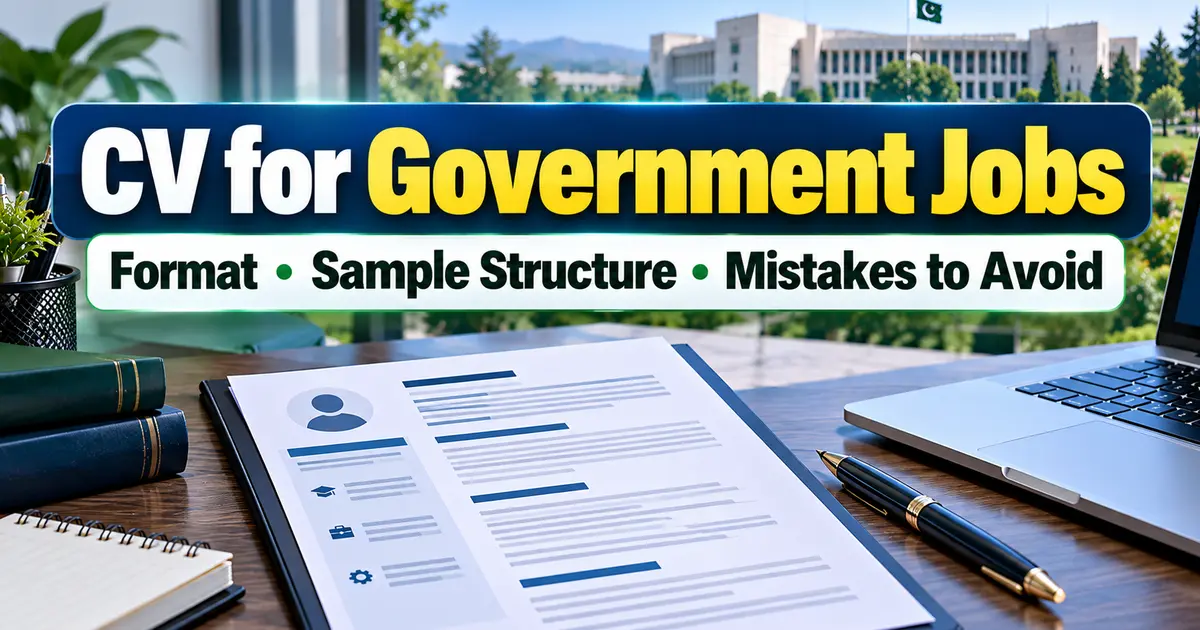
A good CV does not get you a government job on its own. In Pakistan, most government jobs are filled through a written test and interview, and selection follows merit under the rules of the recruiting body. A CV still matters, for two practical reasons. First, some departments, universities, autonomous bodies and contract posts do ask for a CV with the application. Second, even where no CV is asked for, a clear, accurate CV gives you all the facts — education, experience, dates and contact details — in one place, so you can fill the online form correctly and answer interview questions without guessing. This guide shows you how to build a CV for government jobs in Pakistan: the right structure, what to write in each section, what to leave out, and the mistakes that make a strong candidate look careless.
Read This First: Does Your Advertisement Ask for a CV?
Before you write anything, read the advertisement you are applying for.
- If the advertisement asks for a CV, send it exactly in the form asked for — by post, by email, or as an upload — with the other documents listed in the advertisement. Follow any page limit, file format or attestation instruction printed there.
- If the advertisement asks only for an online form — as PPSC and FPSC advertisements normally do — fill the online form. Do not send a CV instead of the form, and do not assume a CV will be read in place of the form. In that case, use the CV in this guide as your master record: keep it updated, and copy facts from it into the form exactly as they appear on your certificates.
- If the advertisement is silent, follow the application method it gives. A CV sent with a complete application does no harm; a CV sent instead of the required form does.
In short: the advertisement decides. A CV supports your application; it never replaces the official form, fee or documents.
The Format That Works for Government Jobs
Government recruiters check facts, not design. Keep the CV simple, clean and easy to scan.
- Length: one page for a fresh graduate, and no more than two pages for most other candidates. If you have long service, two pages are enough — a third page is rarely read in full.
- File: send a PDF unless the advertisement asks for something else. Name the file clearly, for example Ahmed-Ali_CV_Lecturer.pdf — not CV-final-final.pdf.
- Font and layout: one standard font throughout, headings in bold, and the same date style everywhere (for example, Jan 2023 – Dec 2024). Leave white space between sections. Do not use coloured backgrounds, tables inside tables, photos as watermarks, or fancy graphics.
- Order: newest first. Your latest degree and latest job come first, because they are the most relevant to the post you want now.
- Language: simple, correct English. Short sentences. No abbreviations the reader has to guess, except standard ones such as B.A., M.Sc. or HEC, written in full the first time where it helps.
- Truth: every date, degree, mark and job title must match your certificates and experience letters. A CV is checked against documents at scrutiny and interview. An exaggeration that is found out later can end a candidature, even after shortlisting.
Do not copy a CV from the internet and change only the name. Recruiters see the same copied objectives and skill lists again and again, and a copied CV rarely matches the post. Write your own facts in your own words, using the structure below.
Section by Section: What to Write
1. Name and Contact Details
Put your full name at the top, as on your CNIC, followed by:
- Mobile number you actually answer.
- Email address you check daily — a simple address with your name, not a joke address or one you no longer use.
- City and province, or full postal address if the advertisement asks for it.
- LinkedIn or portfolio link, only if it is relevant to the post and up to date.
Do not put your CNIC number, date of birth, religion, salary history or family details on a CV you share widely. Those details belong on the official application form, where the recruiting body asks for them. The one exception is where the advertisement itself asks for a detail on the CV — then include only what it asks for. Check the phone number and email twice. A wrong digit means a call or interview letter that never reaches you.
2. Career Objective or Profile — Short and Specific
Write two or three lines, written for this post — not for every job in the world. A weak objective says: "To work in a reputable organisation and utilise my skills for growth." It says nothing about you, and it could belong to anyone. A useful profile says: "M.Sc. Mathematics graduate with two years of teaching experience at college level, applying for the Lecturer (Mathematics) post. Strong in lesson planning, student assessment and record keeping."
If you are a fresh graduate, say what you studied, what practical work you have done (internship, project, teaching practice), and which post you are applying for. If you are already working, say your current post, your experience, and the post you want next. Keep it honest — do not claim experience or a skill you do not have.
3. Education — Newest First
List each qualification on its own line or in its own short block: degree or certificate name exactly as on the certificate, subject or field, institution name, year of passing, and division, grade or CGPA as shown on the certificate, and board or university name where it is not obvious from the institution.
Example:
- M.Sc. Mathematics, University of the Punjab, Lahore — 2023, First Division.
- B.Sc. (Mathematics, Statistics), Government College University, Lahore — 2021, First Division.
- Intermediate (Pre-Engineering), BISE Lahore — 2019, A Grade.
- Matriculation (Science), BISE Lahore — 2017, A Grade.
Include Matric and Intermediate. Government scrutiny starts from Matric, and leaving them out looks like something is hidden. If you hold a foreign degree, add one line saying whether HEC equivalence has been obtained, or is applied for — do not claim equivalence you do not have. If you are waiting for a result, write "Result awaited" and the expected date, and do not apply for a post that requires the completed degree unless the advertisement allows it.
4. Work Experience — What You Did, Not Just Where You Were
For each job, give the job title exactly as in your appointment or experience letter, organisation name and city, start and end dates (month and year), and two to four bullet points on what you actually did, with real detail. Write duties in plain words, and use numbers only where they are true and you can prove them: the number of students taught, the size of a team supervised, or the volume of record work handled. Do not invent figures to sound impressive.
Example:
- Junior Clerk, District Education Office, Sargodha — Mar 2022 – Present
- Maintain service and leave record of teaching staff and prepare monthly statements.
- Prepare official letters, notices and meeting minutes in English and Urdu.
- Handle public dealing at the office counter and keep a daily diary of visitors.
If you have no paid experience, do not leave this section blank and do not invent a job. Use a heading such as "Internship / Practical Experience" and list real work: an internship, teaching practice, a final-year project, volunteer work, or work in a family business where you can name a person who will confirm it. One honest internship is worth more than a fake job title. If you are already a government servant, list your service in full and keep your Departmental Permission Certificate ready — it is a separate document, not a CV line, but your CV dates must match it.
5. Skills — Only What You Can Do
Divide skills into short groups so the reader can find them:
- Computer skills: for example, MS Word, Excel and PowerPoint; typing speed only if you have actually been tested; any office, accounts or data-entry software you have really used.
- Language skills: Urdu and English, and any other language, with an honest level — for example, "English: reading and writing good, speaking fair."
- Job skills: only skills the post needs, such as record keeping, public dealing, laboratory work, driving with a valid licence, or shorthand, with the certificate or licence that proves it.
Do not list ten skills you have only heard of. In an interview you may be asked to show any skill you claim, and a claim you cannot back up damages the rest of the CV. If a skill is required by the advertisement and you do not have it, do not claim it — and consider whether you meet the eligibility at all before you apply.
6. Training, Certifications and Publications
List short courses, diplomas and certificates that relate to the post, newest first, with the issuing body and year. Examples: a computer diploma from a recognised institute, a teaching training, a first-aid course for a health post, or a published research paper for a lecturer post. Leave out certificates that have nothing to do with the post, and never list a course you did not complete. If you are currently enrolled in a course, write "In progress" with the expected completion date.
7. Domicile, Quota and Other Details — Only Where Relevant
Government posts are often filled under provincial or regional quota, and the advertisement will state which domicile is required. Your domicile is proved by your domicile certificate, not by your CV — but one short line in the CV helps the reader: for example, "Domicile: Punjab (Sargodha district)." Add other details only if the advertisement asks for them or the post needs them: for example, a valid driving licence for a driver post, or registration with a professional council for an engineering or medical post. Do not add age, marital status, number of children, or similar personal details unless the advertisement asks for them.
8. References — Keep Them Ready, Not Always on the Page
You have two honest choices: write "References available on request" at the end and keep the names ready, or list two references with their name, post, organisation and phone or email — only people who have agreed to be contacted and who know your work. Never list a senior officer, teacher or relative without asking them first. A reference who is surprised by a call helps no one.
A Complete Sample Structure You Can Copy
Use this outline and fill in your own facts. Do not copy the example facts.
[Your Full Name]
Mobile: [number] | Email: [address] | City, Province
Career Profile
[Two or three lines: qualification, experience, and the post you are applying for.]
Education
[Degree, subject, institution, year, division/CGPA]
[Degree, subject, institution, year, division/CGPA]
Intermediate: [group, board, year, grade]
Matriculation: [group, board, year, grade]
Work Experience
[Job title, organisation, city — Month Year – Month Year]
[What you did]
[What you did]
Skills
Computer: [list]
Language: [list]
Job skills: [list]
Training and Certifications
[Course, issuing body, year]
Other Details
Domicile: [province / district]
[Licence or registration, only if relevant]
References
References available on request.
That is a complete CV for most government posts. If a section is empty for you — for example, no training yet — leave the heading out rather than filling it with padding. An honest one-page CV beats a padded two-page one.
Tailoring the Same CV for Each Post
Do not send the same CV to every post without reading the advertisement again. Before each application, spend ten minutes on these checks:
- Match the profile line to the post. Change the post title and the one or two strengths that post needs.
- Reorder experience bullets. Put first the duty that matches this post's work.
- Use the advertisement's own words for the degree, subject and experience it asks for — so the reader sees at once that you meet the printed eligibility. Do not change your degree name to fit; use the exact name on your certificate.
- Remove what this post does not need. A long list of unrelated skills hides the relevant ones.
- Check the closing date and the method. A CV sent after the closing date, or by the wrong method, is not considered, however good it is.
Keep one master CV with everything in it, and make a shorter copy for each post from it. That way you never lose a fact, and each application still looks written for that post.
Using Your CV to Fill PPSC and FPSC Forms Correctly
Most commission applications are online forms, not CV uploads. Your master CV makes the form faster and safer: copy degree names, years, marks and institution names from the CV — and check them against the certificates, not from memory; copy job titles and dates from the experience section, so the form and the CV agree; use the same phone number and email on the form and the CV, so later letters and calls reach you; and keep the fee receipt, tracking number and a printout of the submitted form with the CV, in one folder for that post. If the form and the CV ever disagree, the documents decide — and a disagreement found at scrutiny looks like carelessness at best. Keep all three consistent: certificate, CV and form.
Common Mistakes That Weaken a Government CV
- Spelling and grammar errors, especially in your own name, degree name and email address. Read the CV aloud once before sending it.
- Wrong or dead contact details — a changed number, an email you never open, or a typo in either.
- A CV of four or five pages for a post that needs one or two. Long is not impressive; clear is.
- A copied objective that could belong to anyone, and a skill list copied from another CV.
- Fancy design — coloured boxes, unusual fonts, photos across the page, or a file the reader cannot open. Simple PDF wins.
- Missing dates or vague dates such as "2020 – 2022" with no months, or a job with no end date and no "Present".
- Experience that cannot be proved — a job with no letter, a certificate you do not hold, or a skill you cannot show.
- Personal details that do not belong on a CV, such as CNIC number, salary, or family details shared publicly.
- Sending a Word file that changes layout on another computer, instead of a PDF.
- One CV for every post, with the wrong post title left in the profile line.
- Applying with a CV instead of the required form, or after the closing date.
Checklist: Before You Send the CV
- Advertisement read in full — CV asked for, or form only?
- Name, phone and email checked digit by digit.
- Every degree, year and mark matches the certificate.
- Every job title and date matches the experience letter.
- Newest degree and newest job first.
- One or two pages, PDF, clear file name.
- Profile line written for this post.
- No claim you cannot prove at interview or scrutiny.
- Spelling checked, including names of institutions.
- Closing date and sending method confirmed.
Frequently Asked Questions
Do PPSC and FPSC ask for a CV?
Normally they ask you to fill an online form, not to upload a CV. Check the advertisement for the post you want — if it does not ask for a CV, fill the form. Use a CV as your master record for the facts you enter in the form.
How long should a CV for a government job be?
One page for a fresh graduate, and no more than two pages for most other candidates. Include education from Matric onwards, real experience, and relevant skills — and nothing else.
Should I put a photograph on my CV?
Only if the advertisement asks for one. A photograph is not needed on most CVs, and a poor or casual photograph hurts more than it helps. Where a photograph is asked for, use a recent, plain-background passport-size photograph, the same kind used on the application form.
Should I write my CNIC number and date of birth on my CV?
Not on a CV you share widely. Those details go on the official application form, where the recruiting body asks for them. Include them on a CV only if the advertisement itself asks for them there.
What if I have no experience?
Say so honestly. List education, an internship, teaching practice, a final-year project or volunteer work, and the skills you can actually show. Do not invent a job. Many government posts are open to fresh graduates, and the test decides shortlisting.
What if I have a gap in education or work?
Do not hide it by changing dates. A gap explained in one honest line at interview — for example, family responsibility, preparation for an examination, or illness — is far safer than dates that do not match your documents.
Can I use the same CV for a private job?
Yes, with changes. A private employer may want a different profile line, a salary expectation, or a portfolio link. Keep the facts the same, but rewrite the profile and skills for that employer, and remove government-specific lines such as domicile unless they are relevant.
How often should I update my CV?
Every time something real changes: a new degree or result, a new job or posting, a completed course, or a new phone number or email. Update the master CV first, then make the copy for the next post from it.
Read next:FPSC Apply Guide — Complete Step by Step Process with Documents Checklist · How to Apply for Government Jobs in Pakistan — Step by Step · PPSC Online Apply + Challan — Complete Step by Step Guide · How to Prepare for PPSC Examinations 2026 · All Career Guides · Latest Jobs

Leave a comment
Your email address will not be published. Required fields are marked *